

Nimonic bar price is an important consideration for aerospace, gas turbine, power generation, and high-temperature industrial applications. Nimonic is a family of nickel-based superalloys strengthened with chromium, cobalt, titanium, and aluminum, designed to maintain strength and oxidation resistance under extreme heat conditions. Because of its complex alloying system and vacuum melting process, Nimonic bar is significantly more expensive than standard nickel alloys and stainless steels. Pricing depends heavily on grade, heat treatment condition, bar size, certification level, and global nickel market trends.
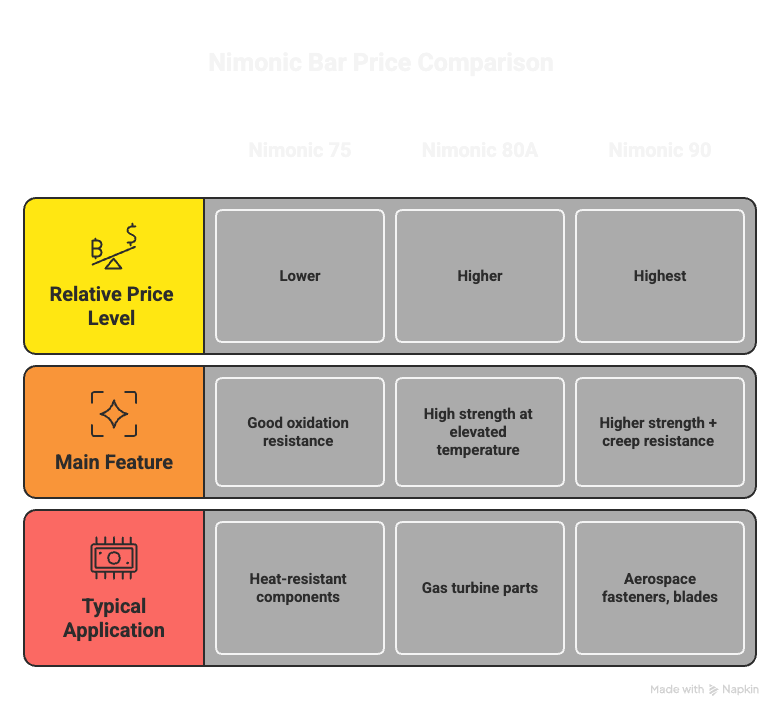
Nimonic Bar Price Overview
Nimonic bars are widely used in high-temperature structural components such as turbine blades, combustion chambers, fasteners, and exhaust systems. The most commonly traded grades include Nimonic 75, Nimonic 80A, and Nimonic 90, each with different strength and temperature capabilities.
| Grade | Main Feature | Typical Application |
|---|---|---|
| Nimonic 75 | Good oxidation resistance | Heat-resistant components |
| Nimonic 80A | High strength at elevated temperature | Gas turbine parts |
| Nimonic 90 | Higher strength + creep resistance | Aerospace fasteners, blades |
What Is Nimonic Bar (Nickel-Based Superalloy Bar Introduction)
Nimonic bar is a solid wrought product made from nickel-based superalloys developed for high-temperature service. These alloys are strengthened by solid solution and precipitation hardening using elements such as chromium, cobalt, titanium, and aluminum.
Average Nimonic Bar Price Per Kg in 2026
Nimonic bar prices are highly sensitive to raw material costs, especially nickel and cobalt. Aerospace-grade material with full certification is significantly more expensive than industrial-grade stock.
| Supply Type | Estimated Price (USD/kg) |
|---|---|
| Industrial Grade Stock | 55 – 95 |
| Mill Production Order | 70 – 120 |
| Aerospace Certified (AMS) | 90 – 160+ |
Nimonic 75 Bar Price vs Nimonic 80A Bar Price
| Grade | Relative Price Level | Reason |
|---|---|---|
| Nimonic 75 | Lower | Less strengthening elements |
| Nimonic 80A | Higher | Improved high-temperature strength |
Nimonic 80A generally costs more due to higher titanium and aluminum content and improved creep resistance.
Nimonic 90 Bar Price Comparison by Grade
Nimonic 90 is typically the highest-priced among common Nimonic grades due to its superior high-temperature mechanical strength and creep resistance in aerospace applications.
Round Bar vs Flat Bar vs Forged Bar Price Differences
| Product Form | Price Level |
|---|---|
| Round Bar | Moderate |
| Flat Bar | Higher due to rolling precision |
| Forged Bar | Highest |
Forged bars require multiple processing steps including forging, heat treatment, and machining, which increases cost significantly.
Nickel, Chromium, Cobalt, Titanium Content Impact on Price
Nimonic alloys contain multiple high-cost elements. Nickel forms the base, while cobalt, titanium, and aluminum increase both performance and raw material cost. Cobalt content has a particularly strong impact on price volatility.
Aerospace Grade vs Industrial Grade Nimonic Bar Price Comparison
| Grade Type | Price Level | Key Difference |
|---|---|---|
| Industrial Grade | Lower | Basic mechanical testing |
| Aerospace Grade | Much Higher | AMS certification + full traceability |
Diameter, Length, and Tolerance Effect on Pricing
| Factor | Price Impact |
|---|---|
| Large Diameter Bar | Higher forging cost |
| Tight Tolerance | Extra machining cost |
| Custom Length | Additional processing fee |
Heat Treatment and Age Hardening Cost Impact
Nimonic bars require controlled heat treatment cycles including solution treatment and aging. These processes improve strength but add furnace time, energy consumption, and quality inspection cost.
ASTM / AMS / BS Standards Certification Cost Impact
Materials supplied with AMS aerospace certification or strict ASTM/BS standards require full traceability, testing, and inspection, which increases total cost.
Manufacturing Process Cost (Vacuum Melting, Forging, Rolling, Machining)
Nimonic bar production typically involves vacuum induction melting (VIM), vacuum arc remelting (VAR), forging, hot rolling, and precision machining. Each step contributes to the final price.
Regional Price Differences (China, USA, Europe, India)
| Region | Market Characteristics |
|---|---|
| China | Competitive pricing, strong export supply chain |
| India | Flexible manufacturing and trading network |
| USA | High aerospace-grade compliance cost |
| Europe | Strict certification and premium pricing |
Typical Nimonic Bar Price Table by Grade and Size
| Grade | Estimated USD/kg |
|---|---|
| Nimonic 75 Bar | 55 – 95 |
| Nimonic 80A Bar | 65 – 115 |
| Nimonic 90 Bar | 80 – 140+ |
How to Get the Best Nimonic Bar Price from Suppliers
- Compare mill direct and stockist pricing
- Choose standard diameters to reduce machining cost
- Combine orders to increase volume discount
- Specify only required certification level
- Monitor nickel and cobalt market trends before bulk purchase
Frequently Asked Questions About Nimonic Bar Price
Why is Nimonic bar so expensive?
Because it contains high-cost alloying elements and requires vacuum melting and complex heat treatment.
Which Nimonic grade is most expensive?
Nimonic 90 and aerospace-certified grades are usually the most expensive due to performance and certification requirements.
Is Nimonic better than Inconel?
It depends on application. Nimonic is often stronger at very high temperatures, while Inconel may offer better corrosion resistance in some environments.


 English
  Korean
  Japanese
  Arabic
  Spanish
  German
  Portuguese
  French
  Russian
  Italian