

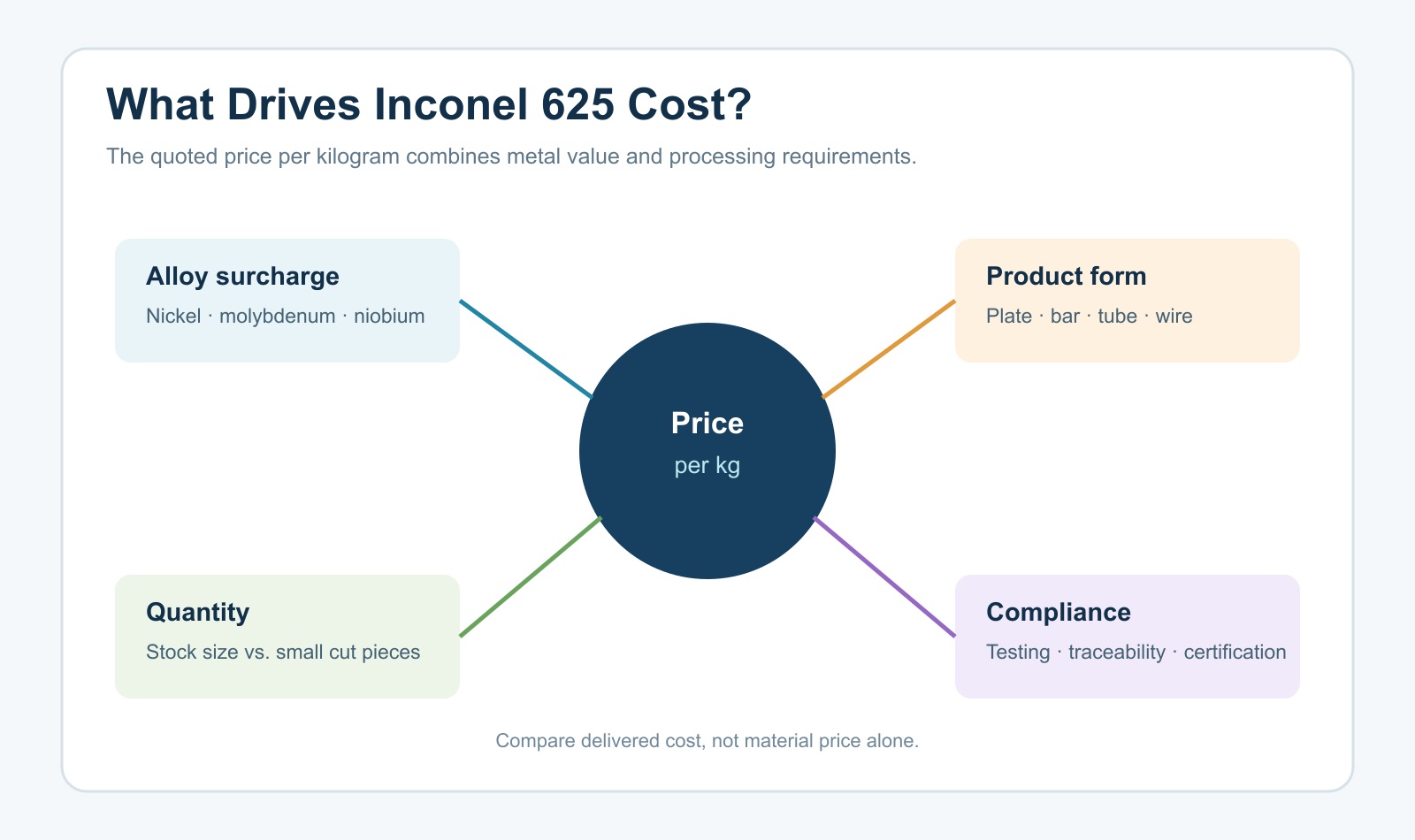
The cost of Inconel 625 per kilogram depends on far more than the base nickel price. Product form, order quantity, manufacturing route, certification, dimensions, heat treatment, surface finish and delivery location can all change the final quotation. Inconel 625 is a nickel-chromium-molybdenum alloy known for excellent corrosion resistance, high strength and reliable performance in demanding temperatures, so its price is normally higher than stainless steel and many conventional nickel alloys. This guide explains typical Inconel 625 price ranges, the factors that influence cost and how buyers can compare quotations accurately.
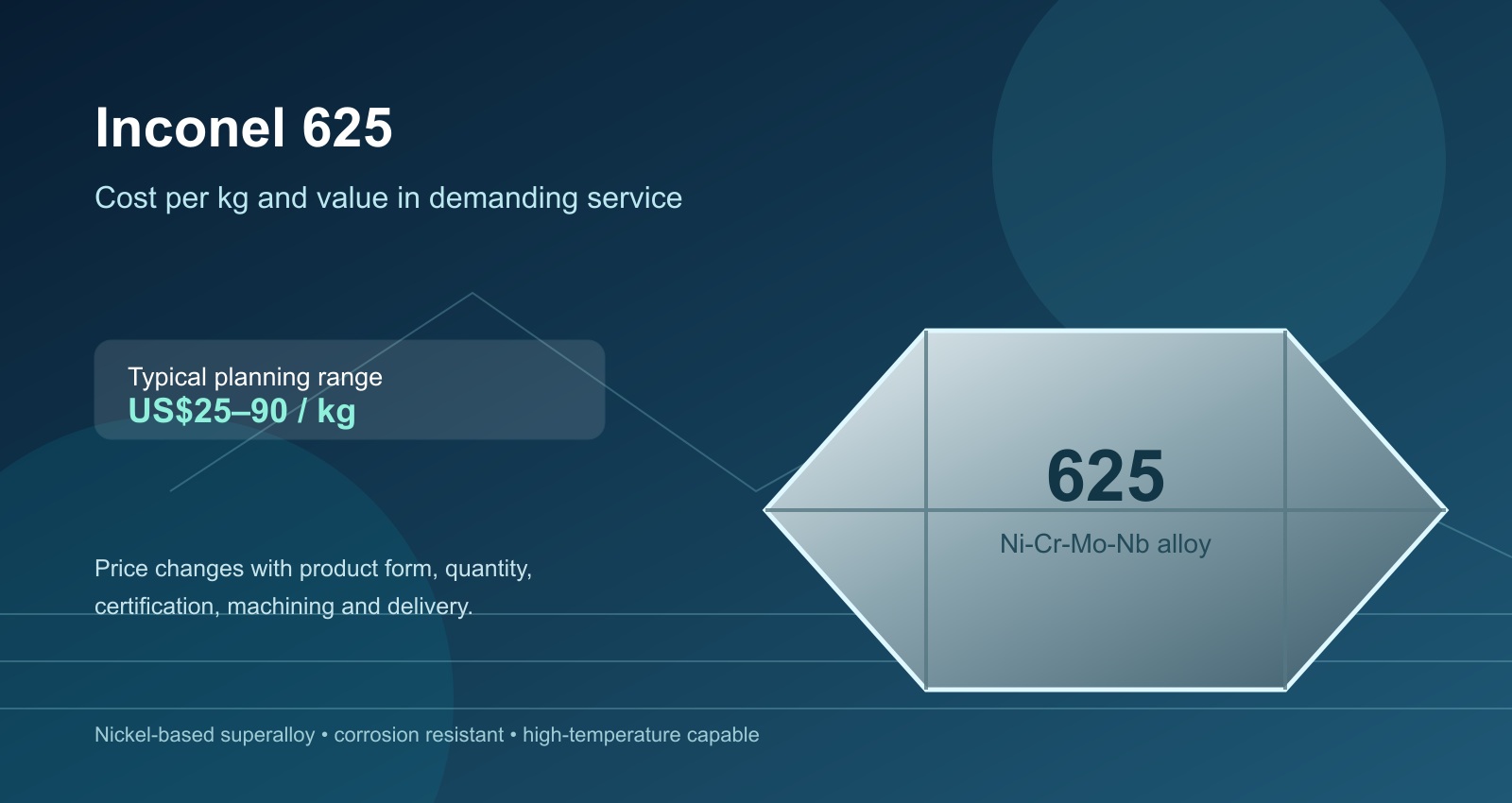
Typical Inconel 625 Cost per kg
As a broad purchasing reference, Inconel 625 may cost approximately US$25 to US$90 per kg for common mill products. Special forms, small quantities and tightly controlled aerospace material can cost considerably more.
| Product form | Typical price range per kg | Main price drivers |
|---|---|---|
| Sheet and plate | US$35–75/kg | Thickness, flatness, cut size, heat treatment and certification |
| Round bar | US$30–70/kg | Diameter, forging route, straightness and machining allowance |
| Wire | US$40–90/kg | Diameter tolerance, drawing stages, surface quality and spool size |
| Tube and pipe | US$45–110/kg | Seamless or welded construction, wall thickness and testing |
| Forgings | US$45–100/kg | Part geometry, forging ratio, ultrasonic inspection and machining |
| Custom machined parts | US$80–200+/kg | Material yield, CNC time, tooling, tolerances and inspection |
| Aerospace-certified material | US$60–150+/kg | Specification, traceability, testing and approved manufacturing source |
These figures are planning estimates rather than fixed market prices. A supplier may quote below or above these ranges depending on the nickel market, availability, order size and the exact requirements in the purchase specification.
Why Inconel 625 Is Expensive
Inconel 625 contains a high percentage of nickel and chromium, together with significant additions of molybdenum, niobium and iron. Nickel is usually the largest cost component, while molybdenum and niobium can also have a strong effect on the alloy surcharge.
The alloy is manufactured for demanding applications where failure can result in substantial safety, maintenance or production costs. Producing consistent Inconel 625 requires controlled melting, refining, hot working, annealing and testing. Compared with ordinary carbon steel, the material is more difficult to melt, forge, roll, draw and machine. Those processing costs are reflected in the price per kilogram.
Inconel 625 Composition and Its Effect on Price
| Element | Approximate content | Cost or performance significance |
|---|---|---|
| Nickel | Balance, commonly above 58% | Major raw-material cost; provides a stable corrosion-resistant matrix |
| Chromium | Approximately 20–23% | Improves oxidation and corrosion resistance |
| Molybdenum | Approximately 8–10% | Enhances pitting, crevice-corrosion and high-temperature resistance |
| Niobium | Approximately 3.15–4.15% | Strengthens the alloy and contributes to weldability and stability |
| Iron | Usually controlled below about 5% | Supports alloy balance but is less expensive than nickel |
| Carbon and minor elements | Low controlled limits | Influence weldability, carbide formation and specification compliance |
Because the alloy chemistry is tightly controlled, low-cost material that does not include reliable chemical certification should be treated carefully. A lower quote may indicate a different grade, incomplete testing, non-standard processing or material that is not fully traceable.
Nickel Market Prices and Alloy Surcharges
Nickel market movements have a direct influence on Inconel 625 cost per kg. However, the relationship is not always one-to-one. Specialty alloy producers commonly apply an alloy surcharge that reflects nickel, molybdenum, niobium, chromium and other input costs, as well as energy and conversion expenses.
When requesting a quotation, ask whether the price is fixed for a defined validity period or adjusted according to a published metal index. For large projects, buyers may negotiate a formula that separates the base conversion price from the monthly alloy surcharge.
Product Form Has a Major Impact
Sheet and Plate
Inconel 625 sheet and plate are often priced according to thickness, width, length, surface condition and whether the material is supplied as a full mill plate or cut-to-size piece. Thin sheet may require several rolling and annealing stages, while heavy plate may involve forging or specialized hot rolling. Small cut pieces frequently have a higher price per kilogram because the supplier must account for cutting, handling and remnant loss.
Round Bar
Round bar prices depend on diameter, tolerance, length and whether the bar is hot finished, cold finished, peeled or centerless ground. Large-diameter forged bar generally costs more than standard hot-rolled bar because it requires additional forging and inspection. Precision-ground bar may carry a substantial machining surcharge.
Tube and Pipe
Seamless Inconel 625 tube is usually more expensive than welded tube because it requires more complex piercing, drawing and annealing operations. Small diameters, thin walls and tight tolerances increase the number of processing steps. Hydrostatic testing, eddy-current testing, ultrasonic testing and dimensional inspection may also affect the final price.
Wire
Wire is commonly produced through repeated cold-drawing stages. Fine wire, welding wire and spring wire require especially careful control of diameter, surface cleanliness, tensile properties and spool presentation. As a result, wire can have a higher price per kilogram than standard bar or plate.
Quantity and Minimum Order Size
Quantity is one of the strongest factors affecting the quoted price. A full heat, production lot or mill bundle usually has a lower cost per kilogram than a small experimental order. Small orders require the supplier to distribute setup, testing, packaging and administrative costs across fewer kilograms.
| Order size | Expected pricing behavior |
|---|---|
| Under 25 kg | Highest unit price; distributor or cut-piece surcharge is common |
| 25–250 kg | Moderate pricing; stock availability has a strong influence |
| 250–1,000 kg | Better commercial pricing with more supplier flexibility |
| Over 1,000 kg | Potential mill-direct pricing, but production lead time may increase |
When comparing suppliers, make sure the quotations use the same net weight basis. One supplier may quote the exact shipped weight, while another may include packaging, cutting allowance or a minimum billing weight.
Specification and Certification Costs
Inconel 625 may be supplied to standards such as ASTM B443 for plate, sheet and strip, ASTM B446 for bar, ASTM B444 for seamless pipe and tube, or other national, industrial and aerospace specifications. Each specification can impose different requirements for chemistry, mechanical properties, heat treatment, grain size and testing.
Material supplied with a basic commercial certificate is generally less expensive than material requiring full traceability and extensive inspection. Additional costs may include:
- Positive material identification
- Heat analysis and product analysis
- Tensile and yield testing
- Hardness testing
- Intergranular corrosion testing
- Ultrasonic, radiographic or eddy-current inspection
- Third-party inspection
- Aerospace or pressure-equipment documentation
Heat Treatment and Surface Finish
Inconel 625 is commonly supplied in an annealed condition, but the exact treatment depends on the product form and specification. Solution annealing, stabilization treatment, stress relief and controlled cooling can add processing time and energy costs.
Surface finish also changes the price. Pickled and descaled material is usually less expensive than bright-annealed, polished, ground or specially cleaned material. If the component will be welded or used in a corrosive environment, surface cleanliness may be important enough to justify the additional cost.
Machining Costs for Inconel 625
Inconel 625 has good strength and corrosion resistance but is not easy to machine. Its low thermal conductivity, work-hardening tendency and high cutting forces can shorten tool life and reduce machining speeds. CNC parts therefore cost more than their carbon-steel equivalents, even when the raw material price is similar on a weight basis.
The finished component price should be calculated from material yield rather than net part weight alone. If a 10 kg component is machined from a 30 kg billet, the buyer is paying for much of the starting material plus cutting and machining time. Complex geometries, deep cavities, tight tolerances and difficult access can increase the total manufacturing cost significantly.
Regional Price Differences
Prices vary by region because of local inventory, import duties, freight, currency exchange, energy costs and the availability of approved mills. A supplier located near a major aerospace or petrochemical market may carry more stock, while another supplier may offer a lower base price but require international shipping and import documentation.
Always compare the delivered cost rather than the material-only price. The delivered cost may include packaging, freight, insurance, customs clearance, taxes and inspection fees.
How to Request an Accurate Inconel 625 Quote
A complete inquiry helps suppliers provide a realistic price and reduces later changes. Include the following information:
- Alloy designation, such as Inconel 625 or UNS N06625
- Product form: sheet, plate, bar, tube, pipe, wire, forging or machined part
- Dimensions, tolerances and required quantity
- Applicable ASTM, ASME, AMS, EN or customer specification
- Required heat-treatment condition
- Testing, inspection and certification requirements
- Surface finish and cutting requirements
- Delivery location and preferred shipping terms
- Required delivery date
Ask each supplier to separate the following items in the quotation:
| Quotation item | Why it should be separated |
|---|---|
| Material price per kg | Allows comparison of the alloy cost itself |
| Conversion or processing charge | Shows rolling, forging, drawing or forming costs |
| Cutting and machining | Prevents hidden preparation charges |
| Testing and certification | Clarifies the cost of compliance and traceability |
| Packaging and freight | Reveals the actual delivered price |
How to Reduce Inconel 625 Purchasing Cost
The most effective savings usually come from improving the purchasing plan rather than selecting an unverified lower-grade substitute. Consider combining several requirements into one order, accepting standard mill dimensions when possible and purchasing from available stock if the lead time is critical.
Design engineers can also reduce cost by avoiding unnecessary machining allowance, specifying realistic tolerances and selecting the correct product form. A near-net-shape forging may cost more per kilogram than bar but less per finished component because it reduces material waste and machining time.
Reusing approved remnants can be practical for small parts, provided the heat number, chemistry, condition and traceability remain documented. Material substitution should only be made after confirming corrosion, temperature, strength and welding requirements.
Is Inconel 625 Worth the Price?
Inconel 625 is often worth its higher purchase price when the component faces seawater, chlorides, acidic media, high-temperature gases, cyclic loading or difficult welding conditions. Its resistance to pitting, crevice corrosion and stress-corrosion cracking can extend service life and reduce maintenance.
The economical choice should be based on total lifecycle cost. A cheaper alloy may require thicker sections, more frequent replacement, protective coatings or additional maintenance. Inconel 625 can provide better value when reliability, corrosion resistance and reduced downtime are more important than the lowest initial material price.
Frequently Asked Questions
What is the average cost of Inconel 625 per kg?
A broad estimate for standard Inconel 625 mill products is about US$25–90 per kg. Sheet, plate and bar often fall within the lower or middle part of this range, while seamless tube, fine wire, aerospace-certified products and small cut pieces can exceed US$100 per kg.
Why does Inconel 625 cost more than stainless steel?
Inconel 625 contains a high level of nickel and substantial amounts of molybdenum, niobium and chromium. These elements are expensive, and the alloy also requires more demanding melting, forming, heat treatment and inspection. Its superior corrosion resistance and high-temperature strength account for the higher purchase price.
How can I get the lowest Inconel 625 price per kg?
Request quotes from several qualified suppliers using identical specifications, quantities and delivery terms. Ordering larger quantities, accepting standard dimensions, using available stock and avoiding unnecessary machining or testing can reduce the price. The material certificate and alloy designation should still be verified before purchase.


 English
  Korean
  Japanese
  Arabic
  Spanish
  German
  Portuguese
  French
  Russian
  Italian