

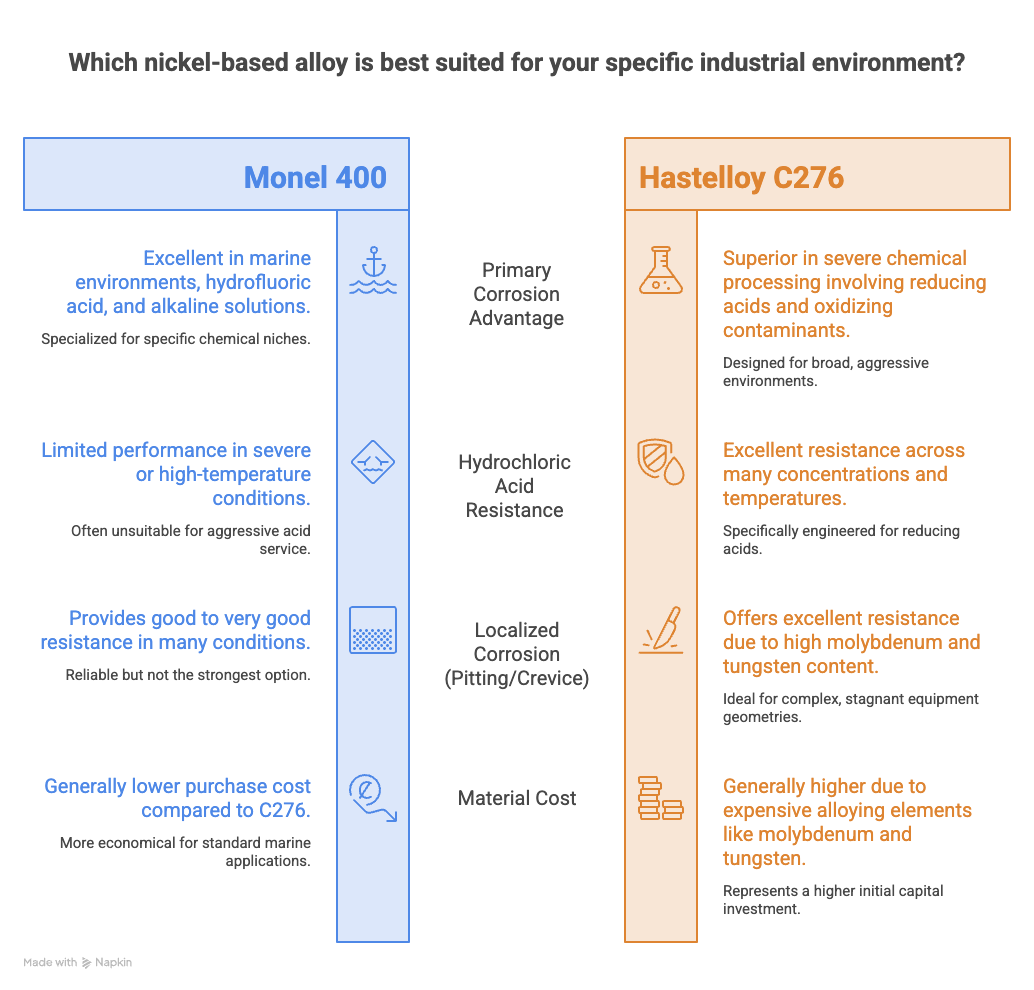
Monel 400 and Hastelloy C276 are both nickel-based alloys used in demanding industrial environments, but they are not interchangeable materials. Monel 400 is a nickel-copper alloy with excellent resistance to seawater, marine environments, hydrofluoric acid and alkaline solutions, while Hastelloy C276 is a nickel-chromium-molybdenum alloy with tungsten that is designed for a broader range of severe chemical environments. When comparing Monel 400 vs Hastelloy C276, the most important difference is not simply which alloy has higher corrosion resistance. The correct choice depends on the chemical medium, acid concentration, chloride level, temperature, mechanical loading, fabrication requirements and expected service life. Monel 400 can be the more practical choice for marine, seawater and hydrofluoric acid applications, while Hastelloy C276 is generally better suited to highly aggressive chemical processing conditions involving reducing acids, oxidizing contaminants, wet chlorine, pitting and crevice corrosion.
What Are Monel 400 and Hastelloy C276?
Monel 400 is a solid-solution nickel-copper alloy containing approximately 63% nickel and 28% to 34% copper, with smaller amounts of iron, manganese, carbon, silicon and other elements. It is one of the best-known nickel-copper alloys and has been used for decades in marine engineering, chemical processing, oil and gas equipment, heat exchangers, pumps, valves and other applications requiring resistance to seawater and selected chemical environments.
One of the most important characteristics of Monel 400 is its strong resistance to hydrofluoric acid, particularly in reducing conditions. It also performs well in alkaline solutions and flowing seawater. In addition to corrosion resistance, Monel 400 provides useful mechanical strength and good toughness over a relatively broad temperature range.
Hastelloy C276 belongs to a different family of nickel-based alloys. It is primarily a nickel-chromium-molybdenum alloy with tungsten and controlled levels of carbon and silicon. Its composition is designed to provide excellent resistance to a wide variety of aggressive chemical environments, including many reducing and oxidizing acids, chloride-containing solutions, wet chlorine and environments where pitting or crevice corrosion is a major concern.
The basic difference can be summarized as follows:
| Characteristic | Monel 400 | Hastelloy C276 |
| Alloy family | Nickel-copper | Nickel-chromium-molybdenum |
| Main alloying elements | Nickel and copper | Nickel, chromium, molybdenum and tungsten |
| Main corrosion advantage | Marine environments, hydrofluoric acid and alkaline solutions | Severe chemical environments and localized corrosion |
| Reducing acid resistance | Good in selected environments | Excellent in many aggressive conditions |
| Oxidizing environment resistance | More limited | Excellent in many conditions |
| Seawater resistance | Excellent | Excellent |
| Wet chlorine resistance | Limited compared with C276 | Excellent in many service conditions |
| Typical selection | Marine, chemical and HF service | Severe chemical processing |
Therefore, Monel 400 vs Hastelloy C276 should be treated as an application-specific comparison rather than a simple “better alloy versus worse alloy” comparison.
Monel 400 vs Hastelloy C276 Chemical Composition
The difference in chemical composition explains much of the difference in corrosion performance between the two alloys. Monel 400 relies mainly on nickel and copper, while Hastelloy C276 uses nickel together with relatively high chromium, molybdenum and tungsten additions.
| Element | Monel 400 | Hastelloy C276 | General function |
| Nickel | Minimum approximately 63% | Balance | Provides the corrosion-resistant matrix |
| Copper | Approximately 28–34% | Very low compared with Monel 400 | Important to Monel’s resistance to selected reducing environments and seawater |
| Chromium | Small amount | Approximately 16% | Improves resistance to oxidizing environments |
| Molybdenum | Very low | Approximately 15–17% | Strongly improves resistance to reducing acids and localized corrosion |
| Tungsten | Very low | Approximately 3–4.5% | Contributes to localized corrosion resistance |
| Iron | Controlled amount | Controlled amount | Part of the specified alloy chemistry |
| Carbon | Low | Very low | Controlled to maintain material performance |
Monel 400 Composition
The high nickel and copper content gives Monel 400 its characteristic combination of corrosion resistance and mechanical strength. Copper is particularly important because it contributes to the alloy’s resistance in hydrofluoric acid and alkaline environments.
However, the same composition does not provide the same broad oxidizing-environment resistance as a chromium- and molybdenum-rich alloy such as Hastelloy C276. This distinction becomes important when selecting materials for complex chemical processes.
Hastelloy C276 Composition
Hastelloy C276 contains significant chromium and molybdenum together with tungsten. Molybdenum and tungsten are particularly important for resistance to localized corrosion and reducing acids, while chromium improves resistance in oxidizing environments.
The alloy also has very low carbon and silicon levels. This chemistry helps reduce the formation of undesirable precipitates during welding and contributes to good corrosion performance in fabricated equipment.
Nickel, Copper, Chromium, and Molybdenum Content Comparison
The biggest chemical difference between Monel 400 and Hastelloy C276 is the role of copper versus chromium and molybdenum.
Monel 400 contains a substantial amount of copper, while Hastelloy C276 contains significant chromium and molybdenum. These different alloying strategies produce different corrosion-resistance profiles.
| Element | Monel 400 | Hastelloy C276 | Why it matters |
| Nickel | High | Very high | Provides the base corrosion-resistant matrix |
| Copper | High | Very low | Important for HF, marine and alkaline environments |
| Chromium | Low | High | Important for oxidizing corrosion resistance |
| Molybdenum | Low | High | Important for reducing acids, pitting and crevice corrosion |
| Tungsten | Low | Significant | Further improves resistance to localized attack |
For this reason, Hastelloy C276 generally has a wider corrosion-resistance envelope than Monel 400 in severe chemical processing. Monel 400, however, has specific environments where its nickel-copper chemistry is highly effective and can make it the more appropriate engineering choice.
Monel 400 vs Hastelloy C276 Corrosion Resistance
Corrosion resistance is usually the most important reason for comparing these two alloys. Both materials provide significantly better corrosion resistance than ordinary carbon steel, but their strengths are different.
Monel 400 provides excellent resistance to seawater and marine environments and is particularly useful in hydrofluoric acid and alkaline service. It also has good resistance to many neutral and reducing chemical environments.
Hastelloy C276 has a broader range of resistance to aggressive chemical environments. Its high chromium, molybdenum and tungsten content provides strong protection against pitting, crevice corrosion and many forms of chemical attack that can be difficult for conventional nickel-copper alloys.
| Corrosive environment | Monel 400 | Hastelloy C276 |
| Seawater | Excellent | Excellent |
| Marine atmosphere | Excellent | Excellent |
| Hydrofluoric acid | Excellent in many conditions | Good to excellent depending on conditions |
| Hydrochloric acid | Limited to moderate depending on conditions | Excellent in many conditions |
| Sulfuric acid | Limited in many aggressive conditions | Very good to excellent in many conditions |
| Wet chlorine | Less suitable | Excellent in many conditions |
| Chloride solutions | Good to very good | Excellent |
| Pitting corrosion | Good resistance | Excellent resistance |
| Crevice corrosion | Good resistance | Excellent resistance |
| Stress corrosion cracking | Good resistance | Excellent resistance in many environments |
These ratings are general engineering comparisons rather than guarantees of corrosion rate. Concentration, temperature, dissolved oxygen, contaminants and flow conditions can change actual performance substantially.
Resistance to Hydrochloric and Sulfuric Acid
When hydrochloric acid and sulfuric acid are involved, Hastelloy C276 generally has a major advantage over Monel 400.
Hydrochloric Acid
Hydrochloric acid is a reducing acid that can attack many stainless steels and nickel alloys. Monel 400 can be used in selected hydrochloric acid conditions, but its performance becomes increasingly limited as concentration and temperature increase.
Hastelloy C276 is specifically designed for aggressive chemical environments and provides much stronger resistance to hydrochloric acid in many concentrations and temperatures. Its high molybdenum content is particularly important in reducing acid service.
If a process involves hot or concentrated hydrochloric acid, Hastelloy C276 should generally be considered before Monel 400, subject to the actual process chemistry.
Sulfuric Acid
Sulfuric acid service is more complicated because corrosion behavior changes significantly with concentration and temperature. Monel 400 is not generally the first choice for highly aggressive sulfuric acid service.
Hastelloy C276 provides better resistance in many sulfuric acid environments, particularly where reducing conditions and mixed chemical exposure are involved. Nevertheless, the exact concentration and temperature should be checked before specifying the alloy.
| Acid | Monel 400 | Hastelloy C276 | Typical selection preference |
| Hydrochloric acid | Limited in severe conditions | Excellent in many conditions | C276 |
| Sulfuric acid | Limited in many aggressive conditions | Very good in many conditions | C276 |
| Hydrofluoric acid | Excellent in many conditions | Condition-dependent | Often Monel 400 |
Resistance to Seawater, Chlorides, and Marine Environments
When seawater or marine service is the main requirement, the comparison becomes much closer. Monel 400 is one of the established materials for marine applications and has excellent resistance to flowing seawater.
Its resistance to seawater, saltwater and marine atmospheres has made it useful for seawater piping, heat exchangers, pumps, valves, shafts, marine fasteners and other components.
Hastelloy C276 also provides excellent resistance to chloride-containing environments and is highly resistant to localized corrosion. However, its broader chemical capability does not automatically make it the most economical choice for ordinary seawater applications.
Marine Water Applications
For a system handling relatively clean, flowing seawater, Monel 400 can be a very practical material. Its corrosion resistance, toughness and established marine performance make it suitable for many applications.
For seawater contaminated with aggressive chemicals, acids, oxidizing species or industrial pollutants, Hastelloy C276 may offer a greater corrosion-resistance margin.
Chloride Solutions
Chlorides are particularly important because they can initiate pitting and crevice corrosion. Hastelloy C276 generally provides stronger resistance to these localized corrosion mechanisms due to its high molybdenum and chromium content.
Monel 400 performs well in many chloride environments, but the presence of high temperatures, stagnant zones, oxidizing contaminants and severe crevices should be evaluated carefully.
Pitting, Crevice Corrosion, and Stress Corrosion Cracking Resistance
Localized corrosion is an important factor when comparing Monel 400 vs Hastelloy C276. A material may have a low general corrosion rate while still being vulnerable to localized attack under certain conditions.
Pitting Corrosion
Hastelloy C276 generally has excellent pitting resistance. Its molybdenum, chromium and tungsten additions work together to improve resistance to localized breakdown of the protective surface.
Monel 400 also has good resistance to many forms of localized corrosion, but Hastelloy C276 is generally the stronger choice when severe chloride-containing conditions create a high risk of pitting.
Crevice Corrosion
Crevice corrosion can occur beneath gaskets, around fasteners, at flange connections and in stagnant areas. These conditions can become highly aggressive because the local chemistry inside the crevice differs from the bulk solution.
Hastelloy C276 is particularly well regarded for resistance to crevice corrosion. This makes it attractive for chemical equipment where joints and stagnant areas cannot be completely eliminated.
Stress Corrosion Cracking
Stress corrosion cracking requires a combination of susceptible material, tensile stress and a suitable corrosive environment. Hastelloy C276 has excellent resistance to SCC in many aggressive chemical environments.
Monel 400 also provides good resistance to stress corrosion cracking in many environments, but its performance should be evaluated against the specific chemical conditions and stress state of the equipment.
| Corrosion mechanism | Monel 400 | Hastelloy C276 |
| General corrosion | Very good in selected environments | Excellent in many aggressive environments |
| Pitting | Good to very good | Excellent |
| Crevice corrosion | Good | Excellent |
| Stress corrosion cracking | Good in many environments | Excellent in many aggressive environments |
| Marine corrosion | Excellent | Excellent |
Monel 400 vs Hastelloy C276 High-Temperature Performance
Both Monel 400 and Hastelloy C276 retain useful mechanical properties at elevated temperatures, but high-temperature corrosion performance must be considered separately from high-temperature strength.
Monel 400 can be used for elevated-temperature applications, but its mechanical strength decreases as temperature increases. It is not normally selected primarily for extremely high-temperature structural strength.
Hastelloy C276 also has good elevated-temperature capability and maintains useful corrosion resistance under many high-temperature chemical conditions. Its main advantage is that it can combine elevated-temperature capability with resistance to aggressive chemical media.
| High-temperature factor | Monel 400 | Hastelloy C276 |
| Elevated-temperature strength | Good | Good |
| High-temperature chemical service | Suitable for selected environments | Suitable for many aggressive environments |
| Oxidizing atmosphere | More limited | Better resistance in many conditions |
| Reducing chemical environment | Good in selected conditions | Excellent in many conditions |
The maximum useful temperature should always be determined from the actual design conditions. Pressure, chemical composition, thermal cycling, stress and corrosion mechanisms all affect the final temperature limit.
Mechanical Properties and Strength Comparison
Mechanical properties are another important difference between Monel 400 and Hastelloy C276. Both alloys can provide high strength and good toughness, but their properties depend on product form, heat treatment and manufacturing condition.
| Property | Monel 400 | Hastelloy C276 |
| Density | Approximately 8.8 g/cm³ | Approximately 8.9 g/cm³ |
| Melting range | Approximately 1300–1350°C | Approximately 1325–1370°C |
| Elastic modulus | Approximately 179 GPa | Approximately 205 GPa |
| General strength | High, especially in cold-worked condition | High |
| Toughness | Excellent | Very good |
| Work hardening | Significant | Significant |
It is important not to compare only nominal minimum tensile strength values because the mechanical properties of both alloys can vary substantially depending on whether the material is supplied as annealed, cold-worked, bar, plate, sheet, pipe or another product form.
Monel 400 Mechanical Strength
Monel 400 has good mechanical strength and excellent toughness. Cold working can significantly increase its yield and tensile strength, which is useful for certain machined and structural components.
The alloy also maintains good ductility and impact resistance, making it suitable for components exposed to mechanical shock and marine operating conditions.
Hastelloy C276 Mechanical Strength
Hastelloy C276 provides a useful combination of strength, ductility and corrosion resistance. Its primary engineering advantage, however, is usually its corrosion performance rather than maximum mechanical strength.
For a pressure-containing component, the actual material specification and required mechanical properties should be reviewed together with the design code and operating temperature.
Weldability and Machining Characteristics
Both Monel 400 and Hastelloy C276 can be fabricated using conventional industrial processes, but both require appropriate procedures because nickel alloys generally require more careful machining and welding than common carbon steels.
Monel 400 Welding
Monel 400 has good weldability when suitable welding procedures and filler materials are used. The material should be properly cleaned before welding because surface contamination can affect weld quality.
Welding procedure selection should take into account the product thickness, joint design, welding process, filler metal and service requirements.
Hastelloy C276 Welding
Hastelloy C276 is also weldable and is commonly fabricated into chemical processing equipment. Its low carbon content is particularly helpful because it reduces the risk of harmful carbide precipitation during welding.
For corrosion-critical equipment, the welding procedure should be controlled carefully to preserve the corrosion resistance of the base material and welded zones. Improper heat input, contamination or unsuitable filler metal can reduce the performance of the finished assembly.
Machining
Both alloys tend to work harden during machining. This means that cutting tools must maintain positive cutting action rather than repeatedly rubbing the surface.
Rigid machine setups, suitable carbide tooling, controlled cutting speeds and adequate coolant are commonly used when machining Monel 400 and Hastelloy C276.
| Fabrication factor | Monel 400 | Hastelloy C276 |
| Weldability | Good with proper procedures | Good with proper procedures |
| Machining difficulty | Moderate to difficult | Difficult |
| Work hardening | Significant | Significant |
| Surface cleanliness | Important | Very important for corrosion-critical service |
Monel 400 vs Hastelloy C276 Price Comparison
Hastelloy C276 is generally more expensive than Monel 400 on a kilogram basis. However, the exact price difference varies according to raw material costs, product form, dimensions, quantity, manufacturing condition, testing requirements and market availability.
The main reason for the higher cost of Hastelloy C276 is its more complex alloy chemistry, particularly its substantial chromium, molybdenum and tungsten content. Molybdenum and tungsten are relatively expensive alloying elements and have a direct influence on the raw material cost.
| Price factor | Monel 400 | Hastelloy C276 |
| Nickel content | High | Very high |
| Copper content | High | Very low |
| Molybdenum content | Very low | High |
| Tungsten content | Very low | Significant |
| Typical material cost | Lower than C276 | Higher than Monel 400 |
| Availability | Generally good | More specialized |
| Machining cost | Moderate to high | High |
For this reason, price alone should not determine the choice. If Monel 400 provides adequate corrosion resistance for a seawater or hydrofluoric acid application, choosing C276 may add unnecessary material cost. Conversely, using Monel 400 in a chemical environment where C276 is required can lead to much higher costs through premature corrosion, maintenance, replacement and production downtime.
What Determines the Actual Purchase Price?
For industrial purchases, the price of Monel 400 or Hastelloy C276 is normally affected by more than the alloy grade. Product form, dimensions, quantity, surface condition, heat treatment, inspection requirements, certification and delivery terms can all affect the final quotation.
For example, a Hastelloy C276 round bar requiring tight dimensional tolerances, ultrasonic testing, PMI, mechanical testing and EN 10204 3.1 certification will generally cost more than a standard stock bar with basic inspection documentation.
Typical Applications of Monel 400
Monel 400 is widely used where resistance to seawater, hydrofluoric acid, alkaline solutions and marine corrosion is more important than resistance to every possible aggressive chemical.
Marine Equipment
Monel 400 is used for seawater piping, pumps, valves, shafts, heat exchanger components and marine hardware. Its resistance to flowing seawater makes it particularly useful in marine systems.
Hydrofluoric Acid Equipment
Monel 400 is one of the established nickel alloys for hydrofluoric acid service. It can perform particularly well under reducing conditions and is used in selected chemical processing equipment.
Alkaline Processing
Monel 400 provides strong resistance to many alkaline solutions and can be considered for caustic processing equipment under suitable conditions.
Oil and Gas Equipment
Selected oil and gas components use Monel 400 where resistance to marine exposure, seawater and specific chemical environments is required.
| Application | Why Monel 400 is selected |
| Seawater piping | Excellent seawater resistance |
| Marine valves | Corrosion resistance and toughness |
| Heat exchangers | Resistance to seawater and selected chemical fluids |
| Hydrofluoric acid equipment | Strong resistance in suitable HF conditions |
| Caustic processing | Good resistance to many alkaline solutions |
| Pumps and shafts | Good mechanical properties and corrosion resistance |
Typical Applications of Hastelloy C276
Hastelloy C276 is generally selected for more aggressive chemical environments where broad corrosion resistance is required.
Chemical Processing Equipment
Hastelloy C276 can be used for reactors, vessels, piping, heat exchangers, pumps, valves and other components exposed to aggressive chemical streams.
Pollution Control Equipment
Wet scrubbers and flue-gas treatment systems can expose equipment to chlorides, acidic condensates, sulfur compounds and other aggressive substances. C276 is frequently considered for these environments because of its resistance to localized corrosion and mixed chemical attack.
Waste Treatment
Industrial waste streams can contain unpredictable combinations of acids, chlorides and oxidizing compounds. Hastelloy C276 is useful where the chemical environment changes during operation and a broad corrosion-resistance range is required.
Chlorine-Containing Systems
Wet chlorine and chlorine-containing chemical streams can be extremely aggressive. Hastelloy C276 is commonly considered for selected components exposed to these conditions.
| Application | Why Hastelloy C276 is selected |
| Chemical reactors | Resistance to aggressive chemical mixtures |
| Process piping | Broad corrosion resistance |
| Wet scrubbers | Resistance to acidic chloride-containing environments |
| Waste treatment | Performance in complex chemical conditions |
| Heat exchangers | Resistance to aggressive process fluids |
| Chlorine equipment | Resistance to wet chlorine and related chemicals |
Monel 400 vs Hastelloy C276: Which Alloy Should You Choose?
The choice between Monel 400 and Hastelloy C276 should begin with the actual operating environment rather than the material price or general corrosion-resistance ranking.
Choose Monel 400 When Marine Resistance Is the Priority
If the main service environment is seawater, marine atmosphere or a suitable marine application, Monel 400 is a strong candidate. Its long history in marine service, good toughness and resistance to flowing seawater make it an established engineering material.
Choose Monel 400 for Suitable Hydrofluoric Acid Service
When hydrofluoric acid is the main corrosive medium and the concentration and temperature fall within a suitable range, Monel 400 can be highly effective. This is one of the environments where its nickel-copper composition provides an important advantage.
Choose Hastelloy C276 for Hydrochloric Acid
If the equipment will handle aggressive hydrochloric acid, particularly at elevated concentrations or temperatures, Hastelloy C276 is generally the stronger candidate.
Choose Hastelloy C276 for Mixed Chemical Environments
When a process contains several corrosive substances at the same time, C276 often provides a greater margin of safety because of its broad resistance to both reducing and oxidizing conditions.
Choose Hastelloy C276 for Severe Pitting and Crevice Corrosion
Where chloride concentration, temperature and equipment geometry create a high risk of localized corrosion, Hastelloy C276 is generally the stronger option.
Consider Total Cost Rather Than Material Price Alone
Monel 400 generally has a lower purchase cost than Hastelloy C276, but the cheaper alloy is not necessarily the lower-cost engineering solution. If the environment requires C276 and Monel 400 suffers premature corrosion, the costs of replacement, maintenance, leakage, downtime and production losses can exceed the original material savings.
| Project condition | Preferred candidate | Main reason |
| Clean flowing seawater | Monel 400 | Excellent marine corrosion resistance and established application history |
| Marine atmosphere | Monel 400 | Excellent resistance and good toughness |
| Hydrofluoric acid | Monel 400 | Strong resistance in suitable conditions |
| Hot hydrochloric acid | Hastelloy C276 | Much stronger resistance in many aggressive conditions |
| Mixed acids | Hastelloy C276 | Broad chemical resistance |
| Wet chlorine | Hastelloy C276 | Strong resistance to aggressive chlorine-containing environments |
| Severe chloride service | Hastelloy C276 | Excellent pitting and crevice corrosion resistance |
| Cost-sensitive marine equipment | Monel 400 | May provide sufficient performance at lower material cost |
Monel 400 vs Hastelloy C276 for Industrial Material Purchasing
When purchasing either alloy for industrial use, buyers should provide more information than just the material grade. A reliable quotation requires the product form, dimensions, quantity, applicable specification, delivery condition, testing requirements and destination.
For example, a request for “Monel 400 bar” may not be enough to prepare an accurate quotation. The supplier may also need the diameter, length, quantity, ASTM specification, heat treatment condition, surface finish, mechanical requirements and inspection documentation.
The same applies to Hastelloy C276. If the material is intended for pressure equipment or severe chemical service, customers may require specific standards, heat numbers, material test certificates, mechanical testing, PMI or nondestructive testing.
For corrosion-critical applications, the chemical service should also be disclosed whenever possible. Knowing that the material will be used in “chemical processing” is less useful than knowing that it will handle a particular acid at a specified concentration and temperature.
Key Differences Between Monel 400 and Hastelloy C276
The comparison can be reduced to several practical differences. Monel 400 is a nickel-copper alloy with a particularly strong reputation in marine environments, hydrofluoric acid and alkaline service. Hastelloy C276 is a more highly alloyed nickel-chromium-molybdenum material designed for broader and more severe chemical corrosion resistance.
| Comparison point | Monel 400 | Hastelloy C276 |
| Alloy type | Nickel-copper | Nickel-chromium-molybdenum-tungsten |
| Best-known corrosion advantage | Seawater, marine service and HF | Severe chemical and localized corrosion |
| Hydrochloric acid | Less suitable in severe conditions | Generally preferred |
| Sulfuric acid | More limited | Generally preferred in many aggressive conditions |
| Seawater | Excellent | Excellent |
| Chloride resistance | Very good in many conditions | Excellent |
| Pitting resistance | Good to very good | Excellent |
| Crevice corrosion | Good | Excellent |
| Mechanical properties | High strength and excellent toughness | High strength and good ductility |
| Material price | Generally lower | Generally higher |
| Typical application | Marine and selected chemical service | Severe chemical processing |
Monel 400 vs Hastelloy C276 Related Questions
Is Hastelloy C276 better than Monel 400?
Hastelloy C276 is generally more resistant to a wider range of aggressive chemical environments, especially hydrochloric acid, mixed acids, wet chlorine and severe chloride-related localized corrosion. However, it is not universally better for every application. Monel 400 can be the better choice for seawater, marine service, hydrofluoric acid and certain alkaline environments, where its nickel-copper composition provides excellent performance at a generally lower material cost.
Is Monel 400 more corrosion resistant than Hastelloy C276?
Not in general. Hastelloy C276 normally provides a broader range of corrosion resistance, particularly in severe chemical environments involving reducing and oxidizing species, chlorides, pitting and crevice corrosion. Monel 400 has specific environments where it performs exceptionally well, especially seawater and suitable hydrofluoric acid service. Therefore, corrosion resistance should always be compared against the actual chemical environment rather than by using one overall ranking.
Which is more expensive, Monel 400 or Hastelloy C276?
Hastelloy C276 is generally more expensive than Monel 400 because it contains significant amounts of expensive alloying elements such as molybdenum and tungsten in addition to high nickel and chromium. The final price also depends on product form, dimensions, quantity, manufacturing condition, testing, certification and delivery requirements. If both alloys can technically satisfy the service requirements, Monel 400 may offer a lower material cost, but the total lifecycle cost should be considered before making the final decision.


 English
  Korean
  Japanese
  Arabic
  Spanish
  German
  Portuguese
  French
  Russian
  Italian