

Finding a reliable Monel K500 supplier is essential when the material will be used in marine equipment, oil and gas systems, chemical processing machinery, pumps, valves, shafts, fasteners or aerospace components. Monel K500 is a precipitation-hardening nickel-copper alloy that combines the corrosion resistance of Monel 400 with substantially higher strength and hardness. However, not every supplier provides the same product quality, certification level, dimensional accuracy or delivery reliability. This guide explains how to evaluate Monel K500 suppliers, what products and standards to request, how to compare quotations and which technical documents should accompany the material.
What Is Monel K500?
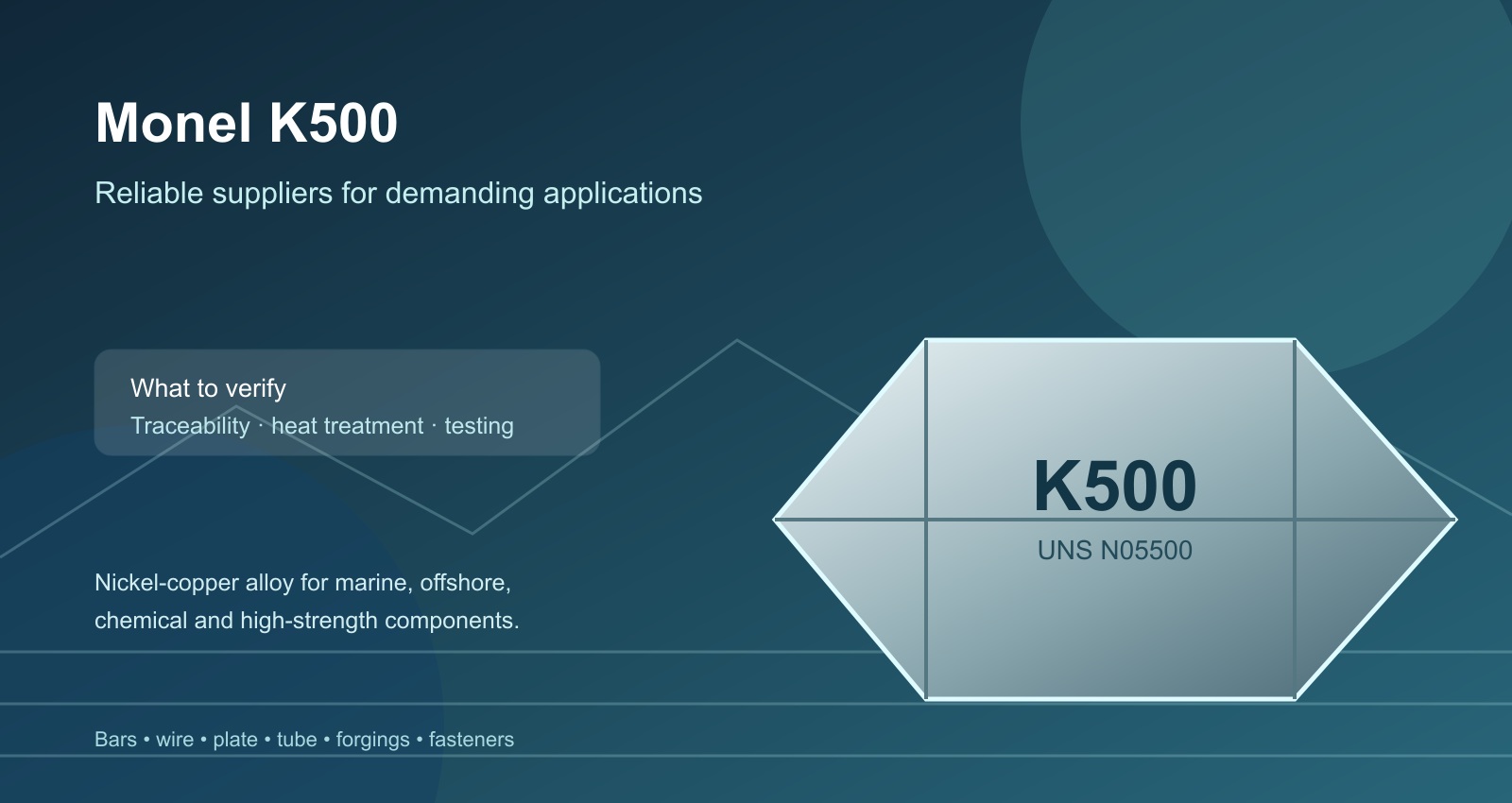
Monel K500, commonly identified as UNS N05500, is a nickel-copper alloy strengthened through the controlled addition of aluminum and titanium followed by heat treatment. The alloy is designed for applications requiring both corrosion resistance and high mechanical strength.
Its nickel-copper base provides good resistance to seawater, hydrofluoric acid, alkalis and many chemical environments. Aluminum and titanium form the strengthening precipitates that allow the alloy to achieve higher tensile strength, yield strength and hardness than Monel 400.
| Property | Monel K500 characteristic |
|---|---|
| UNS designation | N05500 |
| Alloy family | Nickel-copper precipitation-hardening alloy |
| Main strengthening elements | Aluminum and titanium |
| Primary matrix | Nickel-copper solid solution |
| Important advantages | High strength, marine corrosion resistance and good dimensional stability |
| Common products | Bar, rod, wire, plate, sheet, tube, forgings and fasteners |
Types of Monel K500 Suppliers
Monel K500 can be purchased through several types of suppliers. The right source depends on the required quantity, specification, delivery schedule and level of technical support.
Original Manufacturers and Mills
Primary mills melt, refine, hot work, cold work and heat treat the alloy. Buying directly from a mill is usually suitable for large orders, repeat production programs and applications requiring full traceability. Mill-direct purchasing may provide better control over chemistry, mechanical properties and heat-treatment records, but minimum order quantities and lead times are often higher.
Authorized Distributors
Authorized distributors purchase products from recognized mills and maintain inventory for faster delivery. They are often a practical choice for maintenance projects, replacement parts and medium-size orders. A good distributor should be able to provide original mill certificates, heat numbers, inspection documents and clear information about the source of the material.
Stockholders and Metal Service Centers
Specialty metal stockholders typically hold bars, plates, tubes, wire and forgings in standard sizes. Their main advantage is immediate availability. They may also provide cutting, sawed blanks, surface grinding or other preparation services. Before purchasing, confirm whether the material is new production, excess inventory, surplus stock or a remnant from another order.
Forging and Fastener Manufacturers
For bolts, studs, nuts, shafts, rings and custom forgings, buyers may work directly with a forging or fastener manufacturer. These companies can supply finished or semi-finished components rather than raw mill products. The quotation should clearly state the alloy condition, heat treatment, dimensions, thread standard and inspection requirements.
Regional Export Suppliers
Export suppliers may offer competitive pricing and a broad range of product forms. International buyers should pay close attention to the actual manufacturing source, inspection arrangements, export packaging, delivery terms, import documentation and compliance with the requested standard.
Common Monel K500 Products
| Product | Typical applications | Important purchasing details |
|---|---|---|
| Round bar and rod | Pump shafts, valve stems, axles and marine components | Diameter, straightness, condition and mechanical properties |
| Wire | Springs, fasteners, screens and electrical components | Wire diameter, tensile strength, surface and coil or spool weight |
| Plate and sheet | Marine hardware, chemical equipment and fabricated parts | Thickness, flatness, cut dimensions and heat-treatment condition |
| Tube and pipe | Instrumentation, fluid systems and heat-exposed equipment | Seamless or welded construction, wall thickness and testing |
| Forgings | High-load shafts, rings, pressure parts and custom components | Forging ratio, grain flow, ultrasonic inspection and machining allowance |
| Fasteners | Marine, offshore, chemical and high-strength assemblies | Thread form, proof load, hardness, coating and lot traceability |
Monel K500 Chemical Composition
A reputable supplier should provide a chemical analysis that confirms the material meets the specified Monel K500 standard. The exact limits depend on the applicable specification, but the alloy generally contains nickel as the balance, a significant copper content and controlled additions of aluminum and titanium.
| Element | Typical composition or limit | Function in the alloy |
|---|---|---|
| Nickel (Ni) | Balance, commonly 63% minimum | Provides the corrosion-resistant matrix |
| Copper (Cu) | Approximately 27–33% | Improves resistance to seawater and reducing environments |
| Aluminum (Al) | Approximately 2.30–3.15% | Participates in precipitation hardening |
| Titanium (Ti) | Approximately 0.35–0.85% | Forms strengthening precipitates with aluminum |
| Iron (Fe) | Controlled residual level | Limited to maintain alloy performance |
| Manganese (Mn) | Controlled maximum | Restricted residual or processing element |
| Carbon (C) | Low controlled maximum | Controlled to maintain ductility and processing quality |
| Silicon (Si) | Low controlled maximum | Restricted residual element |
Because Monel K500 is precipitation hardened, the aluminum and titanium levels are particularly important. A material that is simply labeled as nickel-copper alloy may not deliver the strength expected from properly heat-treated Monel K500.
Standards to Request from Monel K500 Suppliers
The material standard depends on the product form. Buyers should state the required standard in the inquiry rather than relying only on the trade name.
| Product form | Common reference specification |
|---|---|
| Bar and rod | ASTM B865 or applicable ASME requirements |
| Forgings | ASTM B865 and related forging specifications |
| Plate, sheet and strip | Applicable ASTM or ASME nickel-alloy product specifications |
| Wire | ASTM or AMS wire specifications, depending on application |
| Fasteners | ASTM, SAE, ASME or customer-specific fastener standards |
| Aerospace products | Applicable AMS or approved aerospace material specification |
Always confirm the current revision of the standard. Older specifications may contain different mechanical property requirements, dimensional tolerances or testing provisions.
Heat Treatment and Mechanical Properties
The strength of Monel K500 depends heavily on its heat-treatment condition. Suppliers may offer annealed, solution-treated, aged or precipitation-hardened conditions. The selected condition should match the intended application and fabrication process.
Typical heat-treatment steps may include solution treatment followed by aging. The aging cycle allows aluminum- and titanium-containing precipitates to form in the nickel-copper matrix. These precipitates obstruct dislocation movement and increase hardness and strength.
| Condition | General characteristic | Typical use consideration |
|---|---|---|
| Annealed | Better ductility and formability | Fabrication, forming and machining before final aging |
| Solution treated | Controlled structure before precipitation hardening | Preparation for specified aging treatment |
| Aged or precipitation hardened | Higher strength and hardness | Shafts, fasteners, springs and high-load components |
A supplier should identify the heat-treatment condition on the quotation and material certificate. If the buyer needs a particular tensile strength, yield strength or hardness range, those requirements should be written into the purchase order.
How to Evaluate Monel K500 Supplier Quality
Material Traceability
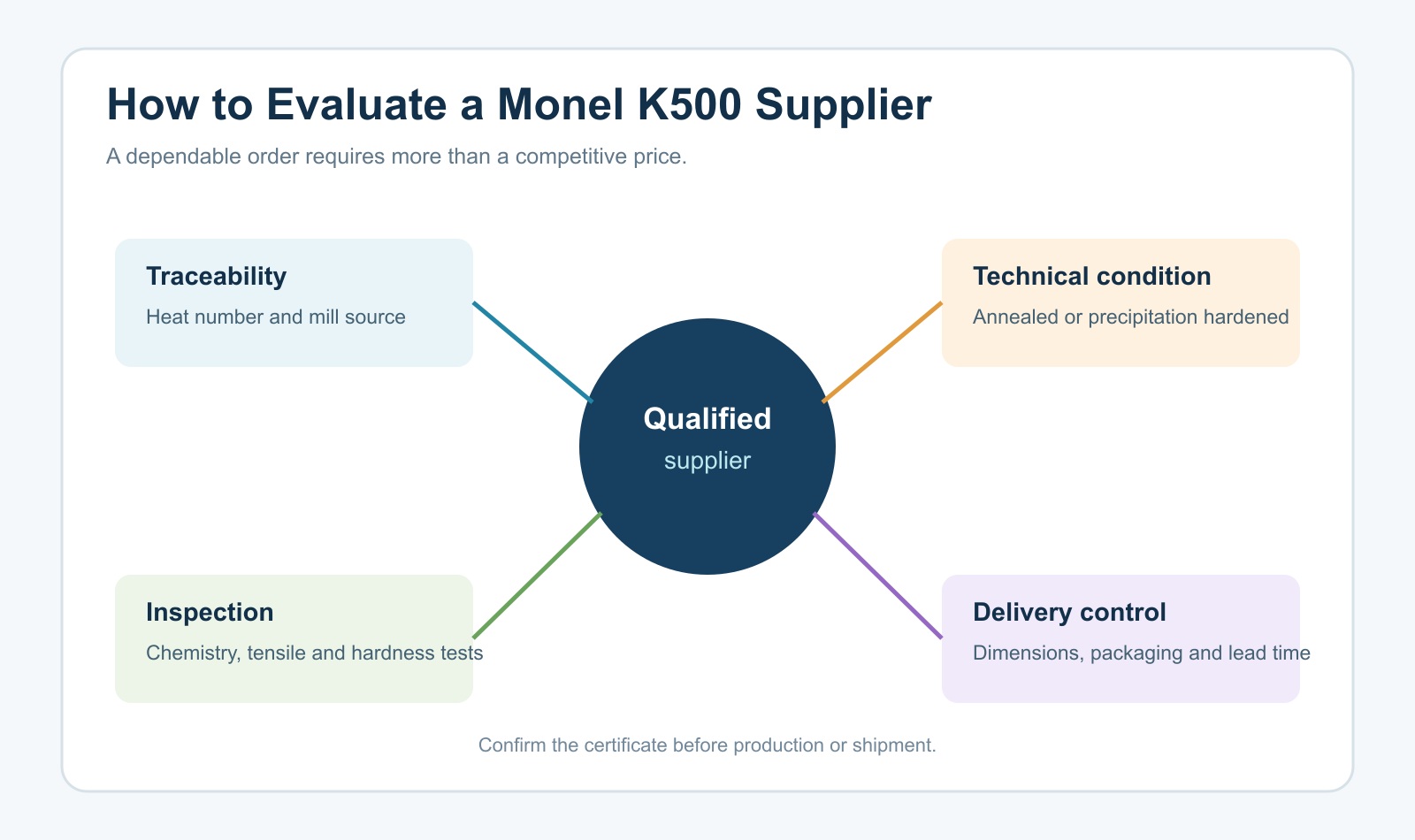
Each lot should be traceable to a heat number or batch number. The marking on the product should correspond with the material test certificate. For cut pieces, ensure that the supplier transfers the heat identification to the remaining material and to the cut part when required.
Mill Test Certificate
The mill test certificate should list the alloy designation, product form, dimensions, heat number, chemical analysis, mechanical properties, heat treatment and applicable standard. Certificates that contain only a generic statement of compliance may not be sufficient for critical applications.
Inspection Capability
Depending on the service environment, buyers may require dimensional inspection, hardness testing, tensile testing, ultrasonic testing, positive material identification or third-party verification. The supplier should confirm which tests are performed in-house and which are completed by an independent laboratory.
Manufacturing Source
Ask whether the supplier is the original mill, an authorized distributor, a stockholder or a trading company. This does not automatically determine quality, but it helps clarify who is responsible for production, documentation and nonconformance resolution.
Previous Industry Experience
Suppliers with experience in marine, offshore, chemical processing, pump manufacturing or oil and gas applications are often more familiar with the documentation and testing required for Monel K500. References, project history and quality certifications can help confirm their capability.
Documents to Request
- Commercial quotation with product description and delivery terms
- Material test certificate or mill test report
- Chemical composition analysis
- Tensile, yield and elongation results
- Hardness report when required
- Heat-treatment record
- Dimensional inspection report
- Non-destructive testing report when specified
- Certificate of origin
- Quality management certification
- Inspection release note or third-party report
- Packaging and shipping documentation
For pressure equipment, offshore projects and safety-critical components, documentation should be agreed before production begins. Late requests for additional testing can increase cost and delay delivery.
Questions to Ask Before Placing an Order
Before selecting a supplier, ask whether the material is available from stock or will be produced specifically for the order. Confirm the expected lead time, minimum order quantity, packaging method and validity period of the quotation.
It is also useful to ask whether the supplier can provide cutting, machining, forging, threading or surface finishing. Combining these services may simplify procurement, but the buyer should confirm that subcontracted operations remain traceable and controlled.
| Question | Why it matters |
|---|---|
| What is the exact material designation? | Prevents confusion between Monel 400 and Monel K500 |
| Which mill produced the material? | Clarifies original manufacturing responsibility |
| Is the product aged or annealed? | Determines strength, machinability and final performance |
| Can the heat number be maintained after cutting? | Preserves traceability for each delivered piece |
| What inspections are included? | Prevents unexpected testing charges or documentation gaps |
| What is the delivery basis? | Clarifies whether freight, insurance and taxes are included |
Monel K500 Supplier Selection by Application
Marine and Offshore Equipment
For seawater pumps, propeller shafts, valve components and offshore fasteners, prioritize corrosion resistance, dimensional stability and proven marine experience. The supplier should be able to provide suitable heat treatment and documentation for long-term seawater exposure.
Oil and Gas Equipment
Oil and gas applications may require strict control of hardness, sulfide stress cracking resistance, sour-service requirements and inspection. The purchase specification may include additional requirements beyond the basic alloy standard.
Chemical Processing
For chemical equipment, verify compatibility with the actual process media, concentration, temperature and pressure. Monel K500 performs well in selected reducing and marine environments, but material suitability should be confirmed by an engineer for each chemical service.
Pumps, Shafts and Wear Components
For shafts, pump parts and high-load rotating components, the supplier should have experience with forging, straightening, aging, machining and balancing. The final component may require a combination of hardness, tensile strength and dimensional inspection.
Fasteners and Springs
Fasteners and springs often require tightly controlled wire or bar properties. Thread accuracy, spring-back, hardness, fatigue performance and surface condition should be included in the specification.
Price Comparison Tips
A low price per kilogram does not necessarily represent the lowest total cost. Compare quotations using the same alloy designation, product form, dimensions, heat-treatment condition, quantity, certification package and delivery terms.
For example, a stockholder may quote a higher material price but deliver within days, while a mill may quote a lower price but require several months for production. If the component is needed urgently, the lower material rate may not be the most economical option.
| Cost item | Possible effect on the final quotation |
|---|---|
| Raw alloy surcharge | Changes with nickel, copper, aluminum and titanium market prices |
| Product size | Non-standard dimensions can increase processing and waste |
| Heat treatment | Required aging can increase production time and energy cost |
| Testing | Additional inspection can add laboratory and handling charges |
| Order quantity | Small lots usually have a higher unit price |
| Freight and import costs | Can substantially change the delivered price |
Common Supplier Mistakes to Avoid
One common mistake is ordering Monel K500 when the application actually requires Monel 400, or ordering Monel 400 when precipitation-hardened strength is necessary. The two alloys are related but are not interchangeable in every application.
Another problem is accepting material without checking the heat-treatment condition. A chemically correct alloy may still fail the required mechanical properties if it has not been processed correctly.
Buyers should also avoid suppliers that cannot provide consistent heat-number traceability, clear product standards or original inspection records. Extremely low pricing can indicate old stock, incomplete documentation, incorrect alloy identification or a product that does not meet the requested specification.
Recommended Purchasing Process
- Define the required product form, dimensions and quantity.
- Identify the correct Monel K500 designation and material standard.
- Specify heat treatment and mechanical property requirements.
- List all testing, certification and traceability requirements.
- Request comparable quotations from qualified suppliers.
- Review the manufacturing source and previous experience.
- Check the sample certificate before placing the order.
- Confirm packaging, marking and delivery terms in writing.
- Inspect the delivered material before releasing it to production.
Frequently Asked Questions
Where can I buy Monel K500?
Monel K500 can be purchased from original nickel-alloy mills, authorized distributors, specialty metal stockholders, forging companies and industrial fastener manufacturers. The best source depends on the required product form, quantity, delivery time, certification and application. Always verify the UNS N05500 designation and request a complete material test certificate.
How do I verify that a supplier is providing genuine Monel K500?
Check the product marking, heat number, chemical analysis, mechanical test results and heat-treatment condition against the material certificate. Confirm that the certificate identifies the applicable standard and original manufacturing source. Positive material identification or independent laboratory testing can provide additional verification for critical orders.
What is the difference between Monel K500 and Monel 400?
Monel K500 has a similar nickel-copper corrosion-resistant base to Monel 400, but it contains aluminum and titanium and is precipitation hardened for higher strength and hardness. Monel 400 is generally easier to form and weld, while Monel K500 is selected when greater mechanical strength and wear resistance are required.


 English
  Korean
  Japanese
  Arabic
  Spanish
  German
  Portuguese
  French
  Russian
  Italian