

Finding dependable Monel 400 suppliers is essential when material performance, delivery schedules, and traceability matter. Monel 400 is a nickel-copper alloy valued for its resistance to seawater, many acids, and alkaline environments, as well as its strength across a wide temperature range. Whether you need sheet, plate, bar, pipe, tube, or custom-cut components, choosing a supplier involves more than comparing the quoted price. Product form, specification compliance, stock availability, documentation, and technical support all affect whether the material will suit your application.
Monel 400 Suppliers: How to Choose a Reliable Source
What Is Monel 400?
Monel 400, commonly designated UNS N04400, is a solid-solution nickel-copper alloy. Its combination of nickel and copper gives it useful corrosion resistance in a range of marine and chemical environments. The alloy is also known for good toughness and strength, including at sub-zero temperatures. Unlike age-hardenable alloys, Monel 400 is generally strengthened through cold working rather than heat treatment.
Material selection still depends on the actual operating conditions. Temperature, fluid chemistry, flow rate, stress, fabrication method, and exposure to contaminants can all affect service life. A qualified supplier can help confirm the requested grade and product form, but final suitability should be checked against the design requirements and relevant engineering standards.
Common Monel 400 Product Forms
Industrial suppliers may offer Monel 400 in several forms. Availability varies by mill, dimensions, quantity, and region, so confirm stock and lead time before placing an order.
| Product form | Typical uses | Details to confirm |
|---|---|---|
| Sheet and plate | Vessels, covers, fabricated equipment, and marine components | Thickness, width, length, finish, and applicable specification |
| Round bar and rod | Machined parts, shafts, fasteners, and fittings | Diameter, tolerance, condition, and cut length |
| Pipe and tube | Process lines, heat-exchange equipment, and fluid-handling systems | Outside diameter, wall thickness, manufacturing route, and end finish |
| Wire and strip | Specialty fabrication, electrical components, and formed parts | Gauge, width, temper, coil size, and surface condition |
| Forgings and custom parts | Pressure-containing or application-specific components | Drawing revision, mechanical requirements, inspection, and certification |
How to Evaluate Monel 400 Suppliers
Verify the Grade and Applicable Specification
Ask the supplier to identify the material by its recognized designation, such as Monel 400 or UNS N04400, and to state the specification applicable to the product form. Do not assume that a generic description like “nickel alloy” is enough to establish material identity. The purchase order should clearly list the grade, dimensions, quantity, required condition, and any governing standard or customer-specific requirement.
Request Material Test Documentation
For critical applications, request a material test report or mill test certificate that matches the supplied heat or lot. Check that the document includes traceable identification and the chemistry and mechanical test results required by the order. If third-party inspection, positive material identification, or additional testing is required, agree on it before production or shipment rather than after the material arrives.
Check Traceability and Quality Controls
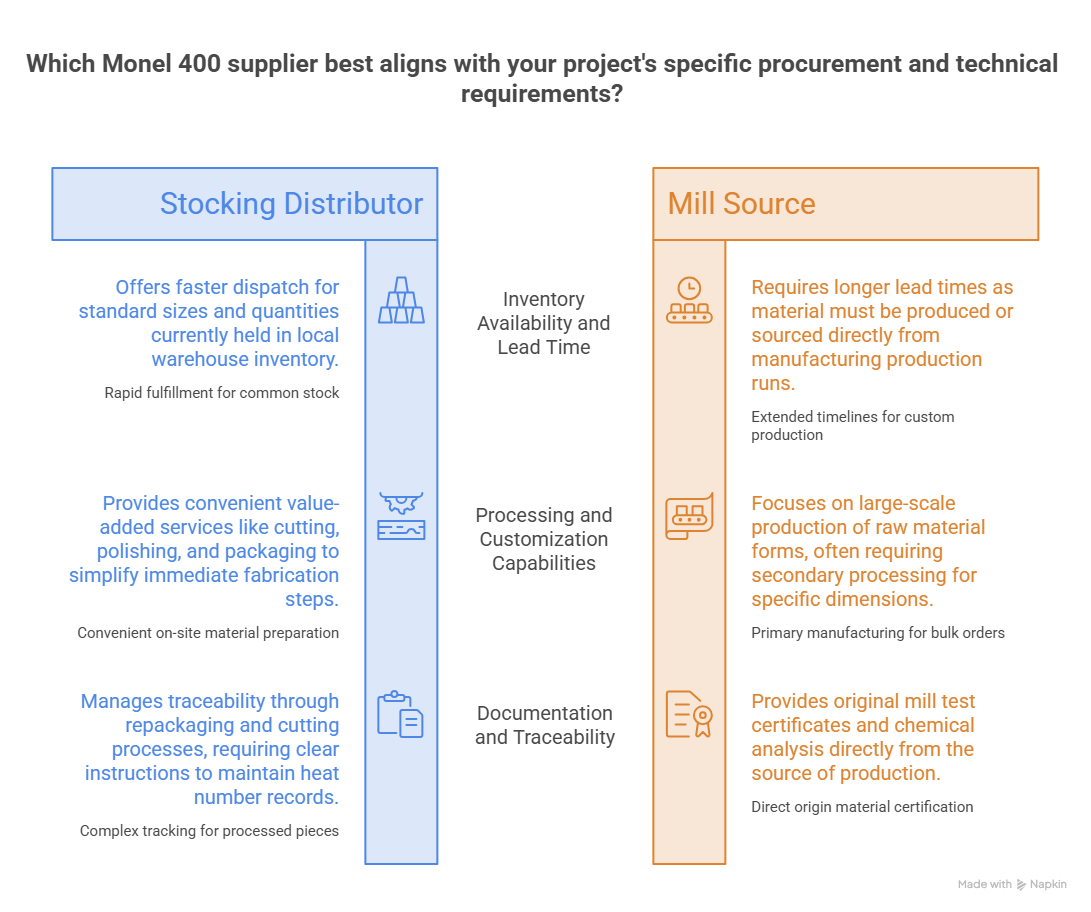
A reliable supplier should be able to explain how material is identified, stored, cut, packaged, and linked to its documentation. Ask whether original heat numbers are preserved through processing and whether certificates remain associated with each cut piece or bundle. For regulated or high-consequence projects, confirm the supplier’s quality procedures and audit requirements in advance.
Confirm Stock, Lead Time, and Processing Capability
“In stock” can mean different things. Confirm the exact size, quantity, product form, and location of the material, along with whether it is available for immediate dispatch or still needs processing. If you need cutting, machining, testing, or special packaging, request a realistic schedule that includes those steps and shipping time.
Assess Technical Communication
Good communication is especially important when a specification is incomplete or the application has unusual service conditions. A capable supplier should ask clarifying questions about dimensions, tolerances, certificates, and delivery requirements. Be cautious of a quotation that makes broad performance guarantees without knowing the operating environment or relevant design criteria.
Questions to Ask Before Ordering
- Is the quoted material Monel 400 / UNS N04400, and what product specification applies?
- Are the requested dimensions and quantity physically available?
- Will each shipment include traceable test documentation?
- Can the supplier provide cutting, machining, inspection, or independent testing?
- What are the production and delivery lead times?
- How are material substitutions handled, and will approval be requested before any change?
- What packaging is available to protect the material during transport and storage?
Monel 400 Supplier Comparison Checklist
| Selection factor | What to compare |
|---|---|
| Material identification | Grade designation, product specification, and condition |
| Documentation | Test reports, heat or lot traceability, and inspection records |
| Availability | Exact dimensions, quantity on hand, and replenishment schedule |
| Processing | Cutting, machining, testing, and packaging options |
| Commercial terms | Price basis, minimum order, freight, payment terms, and quotation validity |
| Communication | Response time, technical clarity, and handling of specification questions |
Understanding Price and Lead Time
The price of Monel 400 can vary with nickel and copper market conditions, product dimensions, manufacturing route, order quantity, processing requirements, and documentation level. A low unit price may not represent the lowest total cost if it excludes certification, cutting, inspection, freight, or other charges. Compare quotations on the same technical and commercial basis.
Lead times depend on whether the required product is already available in the correct size and condition. Standard stock items may ship sooner than special dimensions, large quantities, or custom-fabricated parts. When a project has a fixed schedule, ask the supplier to distinguish confirmed stock from estimated future availability and to state the expected dispatch date in writing.
Information to Include in a Quote Request
A complete request helps suppliers provide accurate, comparable quotations. Include as many of the following details as possible:
- Material designation: Monel 400 / UNS N04400
- Product form: plate, sheet, bar, pipe, tube, wire, or another form
- Applicable specification and required condition
- Dimensions, tolerances, and quantity
- Required certificates, testing, inspection, or traceability
- Cutting, machining, or other processing requirements
- Delivery location and required delivery date
- Packaging or handling instructions
Frequently Asked Questions
What should I look for in a Monel 400 supplier?
Look for accurate grade identification, product-form availability, traceable material documentation, clear lead times, and the ability to meet your inspection and processing requirements. Ask for written confirmation of the specification and dimensions before ordering.
Is Monel 400 the same as UNS N04400?
Monel 400 is commonly identified by the UNS designation N04400. Even so, confirm the product specification and condition on the quotation and order documents, since requirements can differ by product form and application.
What information is needed to request a Monel 400 quote?
Provide the grade, product form, dimensions, quantity, applicable specification, documentation and testing requirements, processing needs, delivery location, and schedule. More complete details make it easier to compare supplier quotations accurately.


 English
  Korean
  Japanese
  Arabic
  Spanish
  German
  Portuguese
  French
  Russian
  Italian